


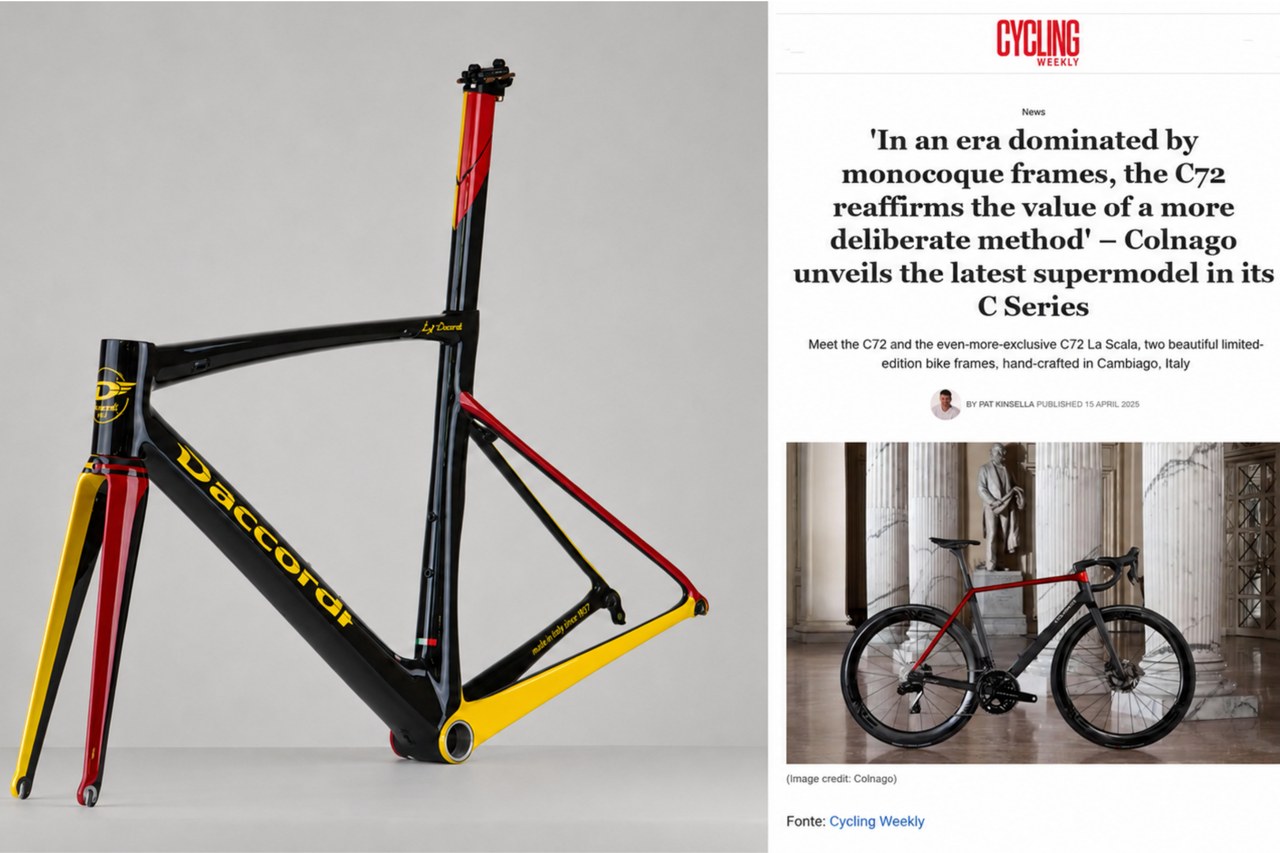
The recent presentation of Colnago’s new model has brought a very interesting message back into focus: one of the world’s best-known bicycle brands has chosen to present its new bike by talking about multi-piece construction, Italian craftsmanship, tubes, joints, force distribution, comfort, stability and cornering precision. In other words, it has brought back to the center of the conversation something we at Daccordi have always said.
Not as an object coming out of a mould, but as a set of different areas that need to work together in order to produce a specific behaviour on the road. And this is an important shift, because for years the market has told a very linear story: the monocoque frame is the best solution, the most modern, the most evolved, the highest-performing. A strong, convenient narrative, repeated so many times that it almost became automatic. But the technical reality is more complex. The monocoque is a very effective production solution for large brands. It allows them to standardize, replicate, produce large volumes, control costs more easily, create highly recognizable shapes and build powerful communication around the product. It is no coincidence that the big brands have pushed it so hard: for large-scale industrial production, it is an extremely convenient path.
The monocoque is not the only technical answer.
This, however, does not mean it is always the best solution for the cyclist. It simply means that it is a solution very well suited to large numbers. And that is a huge difference, because designing a bicycle with production in mind is one thing; designing a bicycle with ride quality in mind is another.
The problem begins when a production choice is turned into an absolute technical truth. When the market starts saying that a monocoque frame is superior not because it is truly always superior, but because it is easier to sell as a symbol of modernity, performance and evolution. At that point, the risk is that the cyclist no longer chooses a bike for the way it behaves, but for the way they have been told it should behave.

A bicycle, however, is not better simply because it comes out of a single mould. It is not better simply because it has more aggressive shapes, more hidden cables, larger sections or more extreme lines. A bicycle is better when, on the road, it gives the rider a precise feeling: control, confidence, responsiveness, stability, comfort, and the ability to transfer power without becoming unnecessarily stiff. And this does not depend on a magic word. It does not depend on whether the frame is monocoque or built in multiple parts. It depends on how it is designed, how it is built, and how the different areas of the frame work together.
This is where the discussion becomes technical. A frame does not need to be equally stiff everywhere. In fact, a bike that is indiscriminately too stiff can become tiring, nervous, and less effective over long distances and on real roads. Stiffness is necessary, of course. It is needed around the bottom bracket, during accelerations, and when pushing hard. But absorption is also needed. Stability is needed. A certain controlled elasticity is needed. A front end that is precise but not twitchy is needed. A rear triangle capable of transferring power without turning every imperfection in the road into fatigue is needed. In one word, balance is needed.
Hand-laid carbon, tubes and joints: where ride quality begins.
And this is exactly where a multi-piece construction, with tubes and joints, or hand-laid carbon, can offer a concrete advantage. Because it allows the frame to be conceived as a structure made up of areas with different functions. The head tube does not work like the bottom bracket. The rear triangle does not work like the down tube. The stays do not need to behave like the seat tube. Each part receives different forces, transfers different stresses, and influences the ride in a different way. Treating everything as a single block may be convenient from a production point of view, but it is not necessarily the most refined way to achieve the best ride quality.
At Daccordi, we have always said this, because we see it every day in our work. When we build a hand-laid carbon frame, we are not simply creating a shape. We are deciding where to place material, where to make it lighter, where to reinforce it, how to orient the fibres, how to make the rear triangle work, how to give solidity to the front end, how to obtain a bike that is responsive when accelerating but still composed and controllable when speed increases. It is not an aesthetic exercise. It is technical construction.
The same applies to frames built with tubes and joints. The choice of the tube, its diameter, its thickness, the material, the geometry and the way the parts are joined together is not secondary. It is the heart of the bicycle. This is where it is decided whether a bike will be stable or nervous, comfortable or harsh, precise or heavy to handle, responsive or empty. Quality does not lie only in the material being declared, but in the way that material is used.
This is why comfort should not be seen as a compromise compared to performance. It is part of performance. A bike that allows you to ride hard for many hours, that remains composed when the road gets rough, that does not force the rider into constant corrections, that gives confidence downhill and precision through corners, is a more effective bike. Not just more comfortable. More effective. Performance is not only the figure measured in a laboratory or the stiffness claimed on a technical sheet. Performance is also what happens after three, four or five hours in the saddle, when the body is tired and the bike must continue to help you, not fight against you.
This is where ride quality comes into play. A word that is often used too little, because it is harder to photograph than an integrated cable or an aerodynamic tube. Yet it is one of the most important qualities of a bicycle. Ride quality is the way the bike enters a corner, the way it remains stable downhill, the way it responds when you get out of the saddle, the way it absorbs the road, the way it allows the rider to feel at the centre of the machine and not simply perched on top of a very stiff frame.
A great bike should not only impress when it is standing still. It has to convince you when the road changes. When the asphalt becomes rough. When the descent gets fast. When there is a crosswind. When the rider is tired. When you need to accelerate out of a corner. When you have to stay in the saddle for hours. That is where you understand whether a frame has truly been thought through, or whether it has simply been designed to look high-performance.

What is interesting about Colnago’s new communication is exactly this: a major brand, with enormous commercial and media strength, has chosen to talk about craftsmanship, multi-piece construction, tubes, joints, force distribution, comfort and stability. In practice, it has chosen to use arguments that for many years were almost considered “small-builder topics”, while today they are being brought back into focus even by those who have the power to influence the global market.
This does not mean that Colnago alone represents the high-end bicycle. Quality does not depend on the size of the brand, the marketing budget or the number of bikes sold. A top-level bicycle can also come from a smaller workshop, with lower numbers and a direct relationship between the person who builds and the person who rides. In fact, it is often precisely there that it becomes possible to make choices that large-scale production cannot afford, because every variation complicates the process, increases time and reduces standardization.
Daccordi works exactly in this space. Not in anonymous production, not in endless replication, not in a bike designed to be more or less suitable for everyone. We build bicycles one at a time, starting from the cyclist, from their measurements, from the way they pedal, from how they will use the bike, from their needs and also from their aesthetic taste. For us, personalization is not an accessory added at the end. It is part of the project.
And this also applies when we talk about exclusivity. Large brands often create limited editions, numbered versions, special colourways linked to events, places or recognizable symbols. It is a precise strategy: to make rare a product that is still born within the logic of a brand. We experience this concept differently. A personalized Daccordi bike does not need a limited series to be special, because it is already born as a unique piece. If the cyclist chooses the geometry, colours, details, components, paintwork and intended use, that bike is not one of many. It is theirs.
Custom bicycles: the most natural limited edition.
A colourway inspired by a theatre, a city or an event can be fascinating. But a colourway born from the cyclist’s story, from their taste, from their way of seeing the bike, is something even more personal. It is not a graphic design created to make an object rare. It is a project built around a person. And for us, this is the deepest meaning of personalization.
In the end, the question is not whether a frame should be monocoque or built in multiple parts. The real question is: what do we want to obtain from that bicycle? Do we want a product that is easy to replicate, or a machine capable of responding to a real cyclist? Do we want a bike built around a mould, or around a riding sensation? Do we want a shape to communicate, or a behaviour to feel in our hands, under our feet, through every corner?
For us, the answer is clear. A bicycle must be designed to be ridden. It must have a logic. It must have balance. It must be built with materials chosen for a reason, with geometries designed for a person, with tubes and layups conceived to obtain a specific behaviour, with colours that are not just decoration but identity.
This is why Colnago’s recent communication choice is interesting. Not because it changes what we do. Not because it tells us something we did not already know. But because it confirms, in front of a much wider audience, that a frame built with care, in multiple parts, by expert hands and with a precise goal in terms of ride quality, still has an extremely strong technical value.
We know this value well. We know it every time we design a custom geometry. Every time we choose a tube. Every time we hand-lay a carbon frame. Every time a cyclist asks us for a bike that is not only beautiful, but right. Right for their body, for their roads, for the way they pedal.
And this, in the end, is the point: not to build bicycles that seem special because they are rare, expensive or hard to find. But to build bicycles that are special because they are born with a precise meaning.




As usual the most perceptive insights on frame building on the net.
Thanks Richard!