

Have you ever noticed that whenever we talk about aerodynamics, the conversation always seems to revolve around something you can buy? Ever more streamlined frames, disc wheels, helmets, skinsuits, shoe covers, aero extensions developed in wind tunnels. Of course, all of these things matter. But the truth is, the heart of a cyclist’s aerodynamics starts at the pelvis.
Ask yourself a simple question: what presents the greater frontal area to the air, the bike or the person riding it? So what makes the bigger difference: the equipment or the position of the body? Remco Evenepoel, with yet another extraordinary performance at the World Championships in Montréal, is living proof.

Remco Evenepole, aerodynamics excellence. Photo by Kakoula10, Creative Commons
There are two types of time trialists. First, there are the giants: those huge powerhouses on a bike who, despite having the aerodynamic drag coefficient of a truck, can put out enough force to practically twist the cranks and frame beneath them. Filippo Ganna, second in Montréal, belongs to this category. But this is a distinct breed that has always existed in cycling: Tony Martin was one of them, and before him Santiago Botero. Go further back and you find Miguel Indurain and Jan Ullrich. All immensely powerful, but all with one major limitation: relatively poor mobility and flexibility, which prevented them from adopting particularly streamlined positions on the bike. Perhaps the most striking example is Miguel Indurain’s failed attempt at the Hour Record: the king of the time trial, yet unable to establish himself against the clock over the hour.
Then there are the aerodynamic specialists. Riders whose exceptional pelvic mobility allows them to rotate their torso further forward while still retaining the ability to produce power. In this respect, what Ganna recently said about his attempts to adopt a more extreme position is particularly revealing: “I lowered my position at the handlebars while keeping the saddle at the same height. That closes the hip angle considerably, but my leg tended to go numb.” Ganna worked specifically on adapting his body to this new posture in order to become more aerodynamic, yet explained that for an effort of around 45 minutes he would still prefer his more conventional position.

Filippo Ganna is unable to adopt on the road the extreme position he uses for the 4 km individual pursuit on the track. Photo: Tim Rademacher / Wikimedia Commons – CC BY-SA 4.0.
It is a perfect example: the position that is theoretically the most aerodynamic is not necessarily the one that allows every athlete to perform at their best. Before the bike becomes the limiting factor, the limitation may lie within the athlete’s own body.
The hips matter twice over. Not only because they allow the torso to fold further forward. Aerodynamics, after all, does not end at the front of the body. In MotoGP, considerable work also goes into shaping the tail section so that the airflow coming off the rider’s back can be managed more effectively, reducing the wake and therefore aerodynamic drag. It is not only about how you enter the air, but also about how the air comes back together behind you.

Suzuki was a pioneer in studying the airflow behind the rider: a smaller wake means less aerodynamic drag and, ultimately, greater speed. Photo: Alberto-g-rovi / Wikimedia Commons – CC BY 3.0.
Remco Evenepoel is the latest example of this particular breed of champion. Before him there were Evgenij Berzin, Serhij Hončar and Aleksandr Vinokurov. Notice anything? All those names come from Eastern Europe, where physical conditioning and all-round athletic preparation were almost a cult for decades: it wasn’t just about watts and the bike. Today, the rider who best embodies these characteristics is Belgian – but a Belgian who came from football and therefore spent years developing his body through comprehensive athletic training, rather than training almost exclusively his legs, as cyclists so often tend to do.
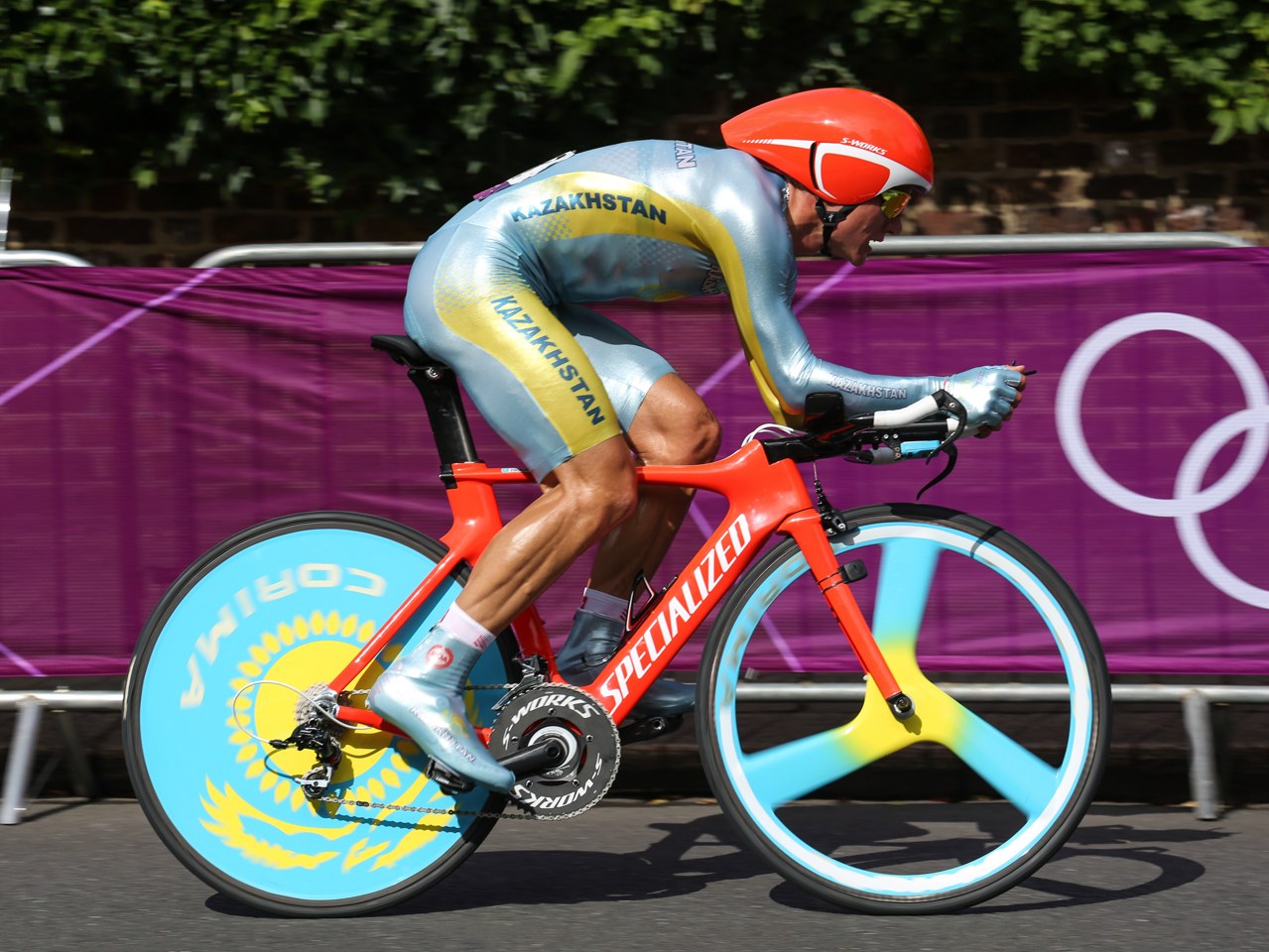
Alexander Vinokourov during the individual time trial at the 2012 London Olympic Games. Despite his highly developed musculature and high muscle tone, he was able to adopt an extremely aerodynamic position by the standards of the time. Photo: David Iliff / Wikimedia Commons – CC BY-SA 3.0.
So, are great time trialists born, made, or bought? To a large extent, they are born: that is where it all begins. Then they are made, through years of work, especially when they are young. Later on, it becomes a matter of adapting and finding the best possible solutions – which, as Ganna himself demonstrates, do not always coincide with those that are theoretically the fastest, particularly when a certain position has to be maintained over time.
And this is where the discussion stops being only about Evenepoel, Ganna and the professionals, and starts to concern all of us.
Because when it comes to technical and technological adaptation, the bicycle should adapt to the rider, not the other way around. There is little point in forcing a stiff rider into Evenepoel’s ultra-compact position and then adding an aero helmet, wheels and components: that does not automatically make it the best position for that rider. We have already discussed in this magazine how a bike rejected by Lance Armstrong went on to win Olympic gold in the hands of Vjačeslav Ekimov: “A Bike for Every Rider. That’s What the Champions Teach Us.”
At Daccordi, this is where we start. First, we try to understand the person who will ride that bicycle: how they pedal, how they move, how flexible they are, which position they can sustain and, above all, in which position they can truly express their power. Only then does the frame come into the picture.
Because designing a bicycle should not mean forcing a person into a predetermined position. It should mean building the bike around that person’s abilities, characteristics and goals. Perhaps that is less glamorous than promising a few watts saved by buying the latest aerodynamic component. But it is the principle we have been building bicycles around for almost ninety years.
You don’t need Evenepoel’s bike. You need the bike that allows you to be the best cyclist you can be.

The item on aerodynamics is excellent; a healthy shift to real analysis and understanding. For his time Anquetil was the essence of aerodynamics, though I did read he suggested he’d have gone faster with a different position.
Thank you for your comment—and for that little gem about Anquetil!