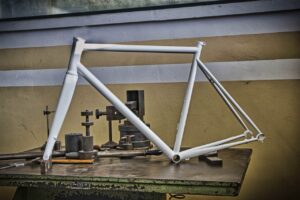


Under almost every welding video we post on YouTube or on our social channels, someone eventually asks the same question: why don’t we weld with TIG? The belief, usually expressed with great confidence, is always more or less the same: TIG would be stronger, cleaner, lighter, more modern, and therefore better. The truth is that the answer is far more complex than that, and that is exactly why we decided to write this long article. Not to fuel a sterile opposition between different techniques, but to explain calmly why, in our way of thinking about a steel frame, fillet brazing is not a nostalgic attachment to the past: it is a precise technical, aesthetic, and identity-driven choice.
The first thing to say: there is no technique that is “better” in absolute terms
When talking about steel frames, the first simplification to avoid is this: imagining that there is some universal hierarchy in which TIG automatically sits above everything else. In reality, tubing manufacturers tell a different story. Reynolds, for example, states that its modern steels 525, 725, 631, 853, and 953 can all be brazed, while TIG is simply the most common joining method today; Columbus, for its part, indicates in its catalogues materials suited both to TIG and to brazing, and for some tube families even specifies that they respond well to both construction approaches. This is an important point, because it tells us that the serious discussion is not “which technique wins,” but “which technique is more coherent with that tube, that project, and the hand of the person building it.”
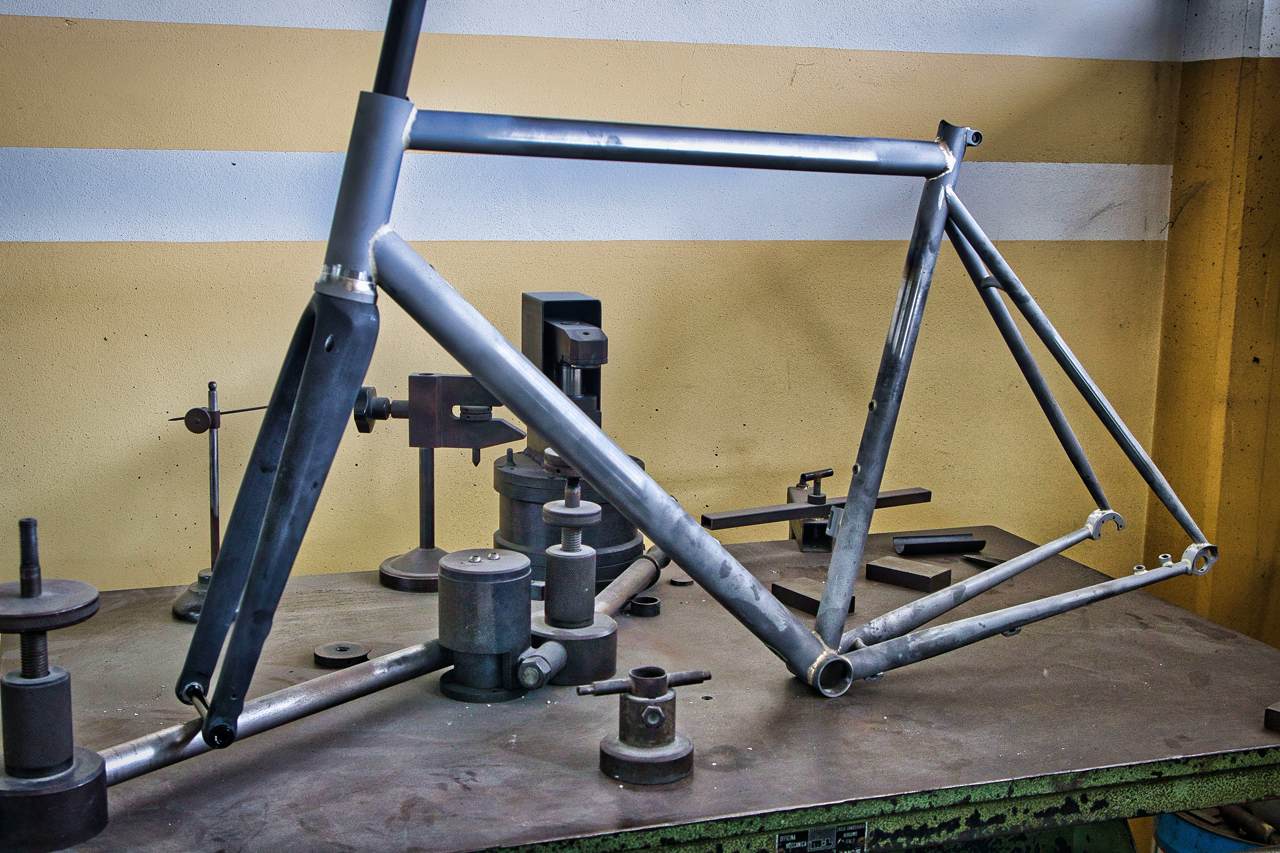
The real issue is not badly explained “strength,” but heat control
Many people imagine the matter in very simple terms: TIG melts steel and uses a steel filler, while brazing uses a lower-temperature alloy; therefore TIG, intuitively, would seem “stronger.” The problem is that, in framebuilding, that shortcut misses the point. In brazing, the base metals are not melted, and Lucas-Milhaupt gives typical temperatures of around 620–870 °C, explaining that for this very reason the base materials can retain much of their physical properties, with less risk of distortion or warping. Miller, speaking about TIG brazing, reinforces the same principle in practical terms: lower temperature means less distortion and less thermal stress on thin material. In a frame, where one is not working with massive pieces but with refined, thin-walled tubing, this is not a secondary detail: it is a decisive part of the final result.
A frame is not a tensile test on two pieces of metal
This is where the most common misunderstanding begins. Those who say “TIG is stronger” usually reason as if a joint were nothing more than the material of the bead itself. But a frame does not work that way. A frame joint works through geometry, continuity, fillet radius, stress distribution, heat-affected zone, fit-up quality, amount of material, and the way that material transfers load into the tube. Lincoln Electric, speaking about welding 4130 used also in bicycle frames, explains something very useful: with ER70S-2 filler, the diluted weld metal may go from about 95 ksi in the base material down to about 80 ksi, but with correct joint design and adequate weld section this difference is more than compensated for. Put simply: real strength is not determined by looking at one number, but by looking at how the joint has been conceived.
So why do so many people think TIG is “stronger,” “cleaner,” “lighter”?
Because TIG, especially in the contemporary imagination, is associated with a very strong idea of technical precision: small beads, a fast process, a modern appearance, and less filler material. But less material does not automatically mean better stress distribution. Joe McEwan of Starling Cycles, who comes from an aerospace engineering background, puts it very clearly: the typical location of failures is often the heat-affected zone, and TIG joints use less material but can also present tighter radii and therefore sharper stress concentrations; on the other hand, a broader brazed fillet works differently and can dissipate stress more effectively. His conclusion is sober and intelligent: both techniques work well, provided the joint is well designed and the frame as a whole is well thought out. That is exactly the point that is too often lost in online discussions.

When a steel frame fails, the problem is rarely “the weld” in the abstract sense
There is another question that deserves to be addressed honestly: why all this almost obsessive attention to the “strength of the weld”? When does a steel frame actually fail because the joining method was, in the abstract, too weak? In practice, when cracks or failures do appear, the sensitive area is much more often the heat-affected zone, or the weld toe, meaning the points where stresses concentrate and where heat has changed the material’s behavior. TWI, in describing cracking phenomena, notes that cracks are found almost exclusively in coarse-grained regions of the HAZ or in the weld metal, often associated precisely with stress concentration areas such as the weld toe; Starling, from a framebuilder’s perspective, observes the same thing in terms much closer to our world. This does not mean that “nothing ever breaks,” but it does mean that the correct reading is not to fixate on the simplistic notion of one technique being “stronger” than another: it is to understand how the real joint works, and where critical points actually arise when a frame has been badly designed or badly built.
Quality steel is thin, sophisticated, and less tolerant of slogans
To fully understand this difference, one must also look at modern tubing. In Columbus catalogues, wall thicknesses appear that, depending on the series, go down to 0.45 mm, 0.4 mm, and in some cases even 0.38 mm; at the same time, Columbus speaks of high fatigue resistance, localized reinforcements in joining areas, and, for families such as Zona or Cromor, reliability, durability, and good resistance to heating during the welding process. This reminds us of something essential: a quality steel frame is not made of “big, indifferent” tubes, but of highly refined, differentiated elements engineered to deliver the maximum performance with the minimum possible wall thickness. When the material is this sophisticated, the issue is not brutally proving that a joint “holds,” but building the best possible balance between strength, durability, ride behavior, and respect for the tube itself.
The history of steel already says far more than many social media arguments
There is also a historical fact worth more than many opinions posted under a reel. Reynolds recalls that 753, one of the iconic tubes of performance steel, was built mainly with silver brazing precisely because of its low melting point, in order to avoid inadvertently annealing the thin tubes. It is only apparently a historical detail: in reality, it tells a construction logic very clearly. When tubes become thin, high-performing, and refined, the way heat is managed becomes an integral part of frame quality. It is not an accessory issue, not an artisanal whim, not a residue from the past. It is a technical choice that accompanied some of the noblest tubes in the history of cycling.

For us, however, the matter is not only technical
At this point, one thing must be said that matters enormously to Daccordi. Our welds have always been one of the defining highlights of our frames. They are not just a structural step, they are not just one phase in the process: they are a language. They are one of the places where you can truly see the hand, the sensitivity, the experience, the patience, and the framebuilding culture behind a bicycle made in a certain way. And that is also why, very often, our bicycles are sold precisely because of this. Enthusiasts look at our welds and appreciate them. They observe them closely, recognize them, read their continuity, their cleanliness, their fullness, the natural flow of the fillet. In those lines they do not simply see “a joint”: they see the level of the frame.
This is not a superficial aspect, nor merely decorative. In a handcrafted frame, beauty does not arrive after technique: it is born together with technique. Lucas-Milhaupt, speaking about brazed joints, also highlights their regular and favorable appearance; we have always known this in a much more concrete way, because it is visible to anyone who takes one of our bicycles in hand. A well-made weld is not only something that causes no problems: it is something that immediately communicates the level of the work. And when an enthusiast stops in front of one of our frames, very often they understand it from that very point.
Why, then, we continue to choose fillet brazing
We continue to choose it because it represents us. Because it allows us to work with steel in the way that feels most right to us. Because it gives us a particular control over the joint, the fillet, and the visual and structural continuity of the frame. Because it does not brutally separate technique and aesthetics, but keeps them together. And because, in a world where everything is too often reduced to fast messages and hasty conclusions, for us it still makes sense to defend the complexity of things done properly.
This does not mean saying TIG is wrong, inferior, or unsuitable in principle. That would be just as foolish as the opposite simplification we are trying to dismantle. It means instead affirming something much more serious: TIG is not automatically better simply because it is TIG. And, likewise, fillet brazing is not “a romantic choice” simply because it requires more handwork and more time. It is a technique that, in the right conditions and in the right hands, has a very deep logic of its own. Technical, structural, aesthetic, and cultural.
The short answer, after the long one
If we had to summarize everything in a few lines, we would put it this way: we do not build our frames with fillet brazing because we do not know TIG, or because we are tied to a museum-like past. We build them this way because we know exactly what we want to achieve. We want a joint that is not only strong, but right. We want to respect the tube, not merely join it. We want the weld to work well, to last, to guide stresses properly, and at the same time to speak the Daccordi language. And we want that, when an enthusiast looks at one of our frames, they immediately understand that there is not only a technique in there: there is a vision.